Preserving The Oral HistorIES of Combat Veterans

For media inquiries, interview requests, documentary use of videos or to learn more about the stories of our veterans, please contact:
Emily Carley
Director, Witness to War Foundation
emily@WitnessToWar.org
770-481-3018
Witness to War Foundation Observes Memorial Day and Celebrates 25 Years of
Preserving Oral Histories of Combat Veterans
Nonprofit’s National Tour Adding to its 3,500+ Combat Veterans Video Library
Atlanta, Ga. (May, 2026) – Witness to War Foundation (WTW), a nonprofit organization dedicated to preserving the oral histories of combat veterans through video interviews, is joining with the nation to observe Memorial Day and to celebrate 25 years of the nonprofit’s work to document the personal stories of U.S. veterans. In 2026, WTW is conducting a national tour to expand the scope of its collection to include remembrances of additional generations of combat veterans and is inviting the public to nominate a combat veteran they know to be interviewed.
Founded in 2001 by entrepreneur Tom Beaty, Witness to War has interviewed more than 3,500 veterans with the mission to preserve their important and historical stories for their families and future generations, and to educate the public on the sacrifices made to preserve our freedoms. WTW’s video library contains interviews with individuals who served in World War II, the Korean War, the Vietnam War as well as in Afghanistan and Iraq, and is working to expand its outreach to include younger generations of combat veterans.
“Memorial Day honors those who died in battle or from wounds sustained in combat and we join with those who returned home in remembering the military personnel who have died in service to our country,” said Emily Carley, director of the Witness to War Foundation. “It is an honor to lift up the memories of combat veterans and help Americans learn about the sacrifices these brave men and women made for our country.”
“In 2001, I attended a meeting with a group of WWII veterans and realized none of them had recorded their stories,” said Tom Beaty, founder of the Witness to War Foundation. “I went to bed thinking what a tragedy it would be if our nation lost all of those stories. I bought a camera the next day and the Witness to War Foundation was born.”
In 2026, the WTW video crew is scheduled to visit several states and events to gather more interviews. In Kentucky and Tennessee, they will meet 187th Infantry Regiment (Rakkasans) veterans and members of the Vietnam Helicopter Pilots Association. In South Dakota, they will interview members of the 173rd Airborne Brigade. In Colorado, they will conduct interviews with Marine combat veterans.
“Many veterans return home and focus on rebuilding their civilian lives and say that one day they will write down their memories for their children and grandchildren,” said Carley. “Through the efforts of Witness to War, these heroic men and women are able to easily share their memories that are now preserved for future generations, loved ones, historians and scholars.”
“On this holiday honoring the memory of combat veterans, we are inviting the public to nominate a loved one who is a combat veteran to be interviewed by Witness to War,” said Carley. For information about how to share your story, please visit https://www.witnesstowar.org/share_your_story. There is no cost to be interviewed and veterans and their families receive free copies of the interview.
“We often hear from people whose loved ones sat for our cameras and are no longer with us,” said Carley. “It is a special honor to preserve these memories for them.”
One such person is Stacey Richey Huddleston of Winter Garden, Florida, who posted on Facebook: “Recently, my sister and I were trying to find exact dates for Dad’s Vietnam service and she stumbled across this website. (Witness to War Foundation). She searched his name and several interviews popped up that we’ve never seen. To hear his voice again is the best gift but these stories are stories that we’ve never heard before either. It is a gift (to hear) Dad opening up about Vietnam, which is something he rarely did for us until we were adults.”
“As we celebrate our 25th year, part of our focus is to encourage younger veterans, from more recent conflicts, to share their experiences while the events are fresh in their minds,” said Carley. “What they have experienced is significant and deserves to be preserved for future generations and recorded so others may learn from their time in the military.”
Witness to War Foundation videos are posted online and easily searchable with hashtags such as #veteranstories plus the war name and military branch. To view videos, visit https://www.youtube.com/@WitnessToWarFoundation.
##
About Witness to War Foundation
The Witness to War Foundation is a nonprofit organization dedicated to preserving the oral histories of combat veterans through video interviews. Founded in 2001 by entrepreneur Tom Beaty, Witness to War has interviewed thousands of veterans with the mission to preserve their stories for their families and future generations, to honor the veterans by posting combat stories on WitnessToWar.org, and to educate the public on the sacrifices made to preserve our freedoms. The Witness to War Foundation is primarily funded by the founder and corporate sponsorship from Resultiv Capital DE, LLC.
July 24, 2017
August 23, 2013
CEO Passions: Collecting War Stories
Tom Beaty's hobby is creating an oral history of U.S. veterans.
By April Joyner | Apr 1, 2009

World War II veterans Christopher Martin
Seven years ago, Tom Beaty began interviewing World War II veterans and videotaping their stories. One veteran walked into a minefield in Italy to rescue friends; another witnessed a sword attack by a Japanese soldier; others crossed the Rhine under enemy fire. The recordings formed the basis of Beaty's nonprofit organization, Witness to War (witness-to-war.org), which is dedicated to preserving stories of veterans, including the World War II vets pictured here. Beaty's interest in oral history began at the University of North Carolina, where he studied military history as an undergrad. He started Witness to War in 2002 -- the same year he launched his business, Insight Sourcing Group, in Norcross, Georgia. Starting two ventures at once often proved hectic, but the interviews provided an escape. "These stories highlight the randomness of war, the constant violence," says Beaty. "Yet a million people have gone through that and survived. How amazing is that compared to my daily life?"
With time swiftly thinning the ranks of World War II veterans, the race is on to capture their memories.
By David Filipov, Globe Staff | March 27, 2010
BOXFORD — Franklin P. Pomroy never told war stories. Not the one about the desperate firefight on
Guadalcanal when the cannon he was manning flew into the air after it fired a single shot. Not the one
about a buddy who was killed with his finger on the trigger of his machine gun, and in death kept shooting
at Japanese soldiers. Not even the story that produced an iconic image of World War II: a 1944
photograph of Pomroy sitting with his head in his hands on a Pacific atoll, exhausted from combat, left leg
spattered with blood.
Like so many veterans of the war, Pomroy for decades spoke of these memories only with the Marines in
his unit. But American World War II veterans are now dying at a rate of about one every two minutes. And
a race is on to preserve their stories before they are lost forever.
Pomroy, now 85, has begun to share his.
On Tuesday, he sat in front of a digital video camera in his Boxford home and recounted the episodes of
camaraderie and bloodshed, wonder and exhaustion, humor and loss that he faced.
“Only recently I realized that this is history and we need to preserve it,’’ Pomroy said during a break in the
recording. “And I’m a walking history book.’’
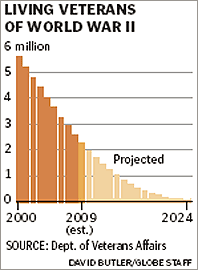
About 2.2 million of the 16 million men and women who served in the US military during World War II are
alive today, according to the Department of Veterans Affairs. The department estimates that 291,000 will
have died between Sept. 30, 2009, and Sept. 30 this year — a rate of
about 800 per day.
 As the World War II generation wanes, interest in publicizing their
stories from foxholes, cockpits, and battle stations grows, a trend
reflected in the popularity of dramatic reenactments such as the new
HBO series “The Pacific.’’ In recent years, the country has also seen
an intensified effort to collect that history, one veteran at a time.
Compiling these stories can be a challenge. Many combat veterans
are uncomfortable sharing their experiences with outsiders, to say
nothing of the entire world of Internet users, said Thomas G. Kelley,
Massachusetts secretary of veterans services, who was awarded the
Medal of Honor and a Purple Heart as a Navy officer in Vietnam. He
finds this especially true with World War II veterans.
“They are a very modest and unassuming crowd,’’ Kelley said in an
interview. “They all have stories, even if they don’t think they do.’’
Tom Beaty, who interviewed Pomroy on Tuesday, is part of that effort. Owner of an Atlanta-based
consulting firm and a military history enthusiast, Beaty, 41, also heads Witness to War, a nonprofit organization that makes digital video interviews of combat veterans. He has set the goal of posting 1,000 interviews with World War II veterans by the end of 2011 on its website, www.witnesstowar.org.
“What’s amazing is a large number of them have never had their histories recorded,’’ Beaty said. “It’s getting very sad.’’
Witness to War is one of a number of projects that aim to collect the stories of the war. The National World War II Museum in New Orleans has a team of four interviewers who travel the country interviewing veterans. They have collected 3,500 video interviews, although they are not yet online, said Kacey Hill, public relations manager for the museum. Pomroy was attending high school in Danvers in 1941 when the football coach cut him, saying the 16-year-old was too small to make the team. “He told me, ‘You’ll get killed out there,’ ’’ Pomroy said.
A year later, Pomroy was killing Japanese soldiers on Guadalcanal. He recalled firing, reloading, firing, reloading, unaware of what was going on 50 feet from his foxhole. He recalled counting the bodies of enemy dead. He recalled the blood, and the silence that follows combat.
“It’s not like a football game, a baseball game, with everybody cheering,’’ Pomroy said. “Real war is bloody, basically. Sometimes, you gotta stand your ground.’’
During the furious hand-to-hand fighting on Peleliu atoll in 1944, Pomroy found himself alone in a marsh, loaded down with weapons he had collected from dead comrades, defending himself from Japanese soldiers. He took three bullets in his right leg and a bayonet in his left. Pomroy killed the man who stabbed him, and later looked in his foe’s wallet and found photographs, probably of the man’s family members. An American amphibious tank finally rescued Pomroy. He was dehydrated and hungry. Blood spattered his left leg, and seeped from the gunshot wounds in his right. Someone snapped the famous photograph.
Now it hangs in the living room of the four-bedroom house Pomroy designed and built that brims with mementos of his life after the war. He has grandchildren. He roots for the Patriots and Red Sox. The last time his unit, H Company, Second Battalion, First Marine Division, had its annual reunion, “six or eight guys showed up.’’
Some veterans Beaty approaches never considered recording their stories for posterity. Llewellyn Jenkins, 90, who fought from France to Czechoslovakia, was one of them.
“The war effort was part of my life; I leave it alone,’’ said Jenkins, who splits time between Chatham and Arizona. “I moved on.’’
He got a job in a bank, married, and had four children. He rose to vice chairman of the board and was president of the American Bankers Association. But he agreed to talk to Witness to War. As a second lieutenant in the 26th Infantry Division, Jenkins’s job was to spot enemy targets, and radio their positions to artillery units in the rear so they knew where to shoot. His position was on the front line, and enemy snipers would recognize him by his radio, and target him because of the firepower he commanded.
One time on a ridge somewhere east of Nancy, France, Jenkins was on the front, observing a German position, and moved too far out of his foxhole.
“The sniper bullet pinged in the dirt and I was, like, ‘Where did that come from?,’ ’’ he recalled. “The next one he put within a quarter inch of my right ear.’’
An American sniper team shot and killed its German counterpart. Later on, a flock of geese flew over the battle lines.
“Everybody on both sides let loose at the geese,’’ Jenkins recalled. “It was like we were having a grand old holiday for a few minutes.’’
“As far as I could see,’’ he chuckled, “not one goose got hit.’’