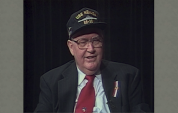
1:30 | Thomas Fitzgibbons remembers the atrocities of war in Northern Italy
Keywords : partisans war crime
Thomas Fitzgibbons tells of hand to hand fighting in the streets of an Italian town

They fought hard to take and keep the top of that hill. Both sides had on white snow gear and you couldn't tell friend from foe. Glen Gooch describes the action which earned him a Bronze Star.
The officer stumbled upon a group of men hunkered down in a gully during the battle of Aachen. Where's the line? Right here. Where are the Germans? Right over there. Who's in charge here? Silence. Finally, they pointed to Antonio Mendez. He had put the ad hoc group of GIs together and rallied them to fend off the Germans, worthy of a Silver Star. Part 2 of 2.
Michael Mirson was a prisoner of the Germans but that was actually better than being in the Russian Army. He was a trained veterinarian so he was valuable to them as they retreated from the Caucasus. One day, an officer told him that the Americans were fifty kilometers away in that direction and the Russians were close in every other direction. That began a mad dash to the American line.
The ice at the Sauer River seemed like it would hold him up but, loaded down with gear, Glen Gooch broke through into the freezing water. He was OK but chilled to the bone. The objective was a hill that the Germans were using for observation.
As the fighting raged around Aachen, Antonio Mendez watched men fall all around him. The Germans had a tank with an 88 dug in and it was forcing them to withdraw. Antonio Mendez saw a perfect spot for cover and dove in. He yelled for others to join him and they soon had a good fighting position set up. Before it was over, he had earned a Silver Star. Part 1 of 2.
He didn't even notice that he'd been hit. A piece of shrapnel from a Japanese artillery shell found Harold Barber's leg but he kept right on fighting because of the adrenaline. The Corpsman bandaged him and he was right back in the battle for Peleliu. The Navy was able to stay and take part in the fight unlike when he was on Guadalcanal.
Because of illness, Glen Gooch didn't ship out with his friends from basic training. They were put through the wringer at Utah Beach and he would see the same kind of action when he arrived a few weeks later as a replacement.
In the middle of the night, thousands of paratroopers loaded into C-47's for the crossing into Normandy. Carl Beck was just a teenager but he was ready. His plane was hit by flak when it neared the drop zone and the jump was rushed, resulting in scattered men and equipment. Part 1 of 2.
Two engines were out, a third smoking, and they were were losing airspeed and altitude, but they were flying level and pointed home. Then time ran out for the B-17 and Don Scott had to slip down the hatch into the slipstream. Part 2 of 3.
Glen Gooch recalls a man in his unit who had a personal vendetta against the Germans. He fought them viciously because of what they did to his brother. It was late enough in the war that they were taking many prisoners, although one in particular still had a little fight in him.
After a nerve-wracking mission to bomb Tokyo and a typhoon, B.E. Vaughan and the destroyer O'Brien suffered a second kamikaze attack which killed all three of his hometown pals who served with him on board. Then, began the grim task of collecting the personal belongings of the dead and preparing them for burial at sea.
Frank Pomroy prepared his last stand. He had a bayonet wound and three machine gun bullets in his leg but he was still ready to fight. He lined up his hand grenades on the coral ridge in front of him and waited. At daybreak he heard Japanese voices coming. Part 4 of 4. (Second interview)
It was their third mission over Berlin and they were heading home. Four German fighters pounced on the B-24 and it was engulfed in flame and going down. Clyde Burnette fought for consciousness as the other crew in the back of the plane bailed out. He woke in free fall with no idea how he had made it out, and soon he was in German custody. Everyone made it out of the plane except George "Danny" Daneau, the nose turret gunner, who went down with the aircraft.
The first operation for the 4th Division was the landing on Roi-Namur. Lawrence Snowden remembers that, though it was an easy victory, valuable combat experience and important lessons were imparted on the Marines.
The combat could be close at times with the Germans right up in your face. Glen Gooch was worried about one young soldier who wasn't very careful when the action started and, sure enough, he came to a bad end.
After a stop in New Zealand where the men made their own liberty, the Marines of the 1st Regiment went to the island of Guadalcanal. It had been chosen for the initial confrontation with the Japanese. Frank Pomroy was ordered to stay on the transport to help unload but an enemy torpedo bomber crashed into it and the crew abandoned ship. Part 1 of 2. (First interview)
Would it be Europe or the Pacific? When Burt Vardeman's crew was sent to Virginia, they knew it would be Europe. They crossed the Atlantic on a Liberty ship and went ashore in Italy. They would be flying their bombing missions from there.
As soon as Glen Gooch left the chaos and destruction of the Hurtgen Forest, he ran right into the desperate German attack at the Battle of the Bulge. It was a running battle and his unit was nearly surrounded at times while playing cat and mouse with Tiger tanks.
In combat, you have tunnel vision. Frank Pomroy experienced that when he faced waves of Banzai charges on Guadalcanal. They were intended to frighten you enough that you turned and ran but it didn't work on the young Marines. (Second interview)
Newton Riess did not like the position where his platoon was placed and he mentioned it to a captain to no avail. Sure enough, his unit was nearly routed by the Germans. He was hit by shrapnel again and sent to the hospital where he saw some ladies from the Red Cross doing something deceitful.
He'd had his feet frozen but Glen Gooch hadn't been shot yet. It was twelve days before the end of the war when German bullets finally found him near Nuremberg.
After the end of the war, George Stamps had a different kind of mission. His entire bomb group would fly to Austria and pick up newly released French POW's and fly them home. It sounded simple.
Jesse Oxendine never really had any close calls with the Germans in combat, but he came close to getting injured by his own comrades. He recalls the time a buddy got shot because of carelessness. The enemy did have a clear shot at him when he was helping some civilians recover their belongings. They didn't take it.
Glen Gooch tells what it was like to capture a German soldier for intelligence purposes. You had to be fast and strong.
Frank Pomroy had left a man for dead on the Guadalcanal battlefield. Everyone agreed that he was dead and they pressed on. But he wasn't and, after almost being buried alive because he could not speak, the two encountered each other in the rear area. This was only the beginning of his sad story. (First interview)
The German guards had fled in the night. The next day, a Russian tank was at the gate of the POW camp and, soon, a Russian general to go with it. Downed pilot Clayton Nattier recalls that the Russians wanted to remove the men to Soviet territory, but the senior Allied officer wasn't having it.
Glen Gooch describes how his company commander received a concussion during an artillery barrage and how he came to earn two awards during the Battle of the Bulge.
Drafted out of high school in 1943, Burt Vardeman went to basic with the Army Air Corps. He scored high on radio aptitude and trained as a radio operator on a B-24 crew. Flying out of Italy, he had a close call when one engine after another failed on the return flight. The order came from the pilot, prepare to bail out!
No one was supposed to know where they were, but as the men of Jim Sharp's unit were marching through the darkness on their way to board a ship for France, a lone woman followed. (Interview conducted in partnership with the Eisenhower Foundation as part of their Ike's Soldiers program. https://eisenhowerfoundation.net & http://ikessoldiers.com)
There was an incredible barrage from German 88s in the Hurtgen Forest but it wasn't the tree bursts that nearly killed Glen Gooch. A German hand grenade came his way.