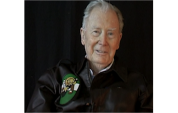
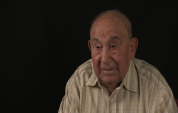
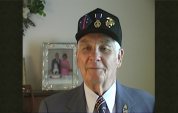
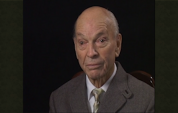
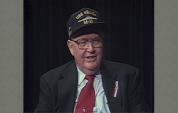
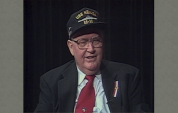
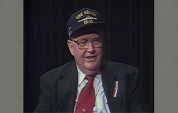
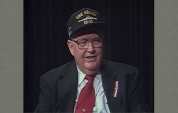
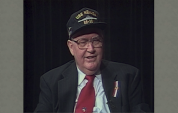
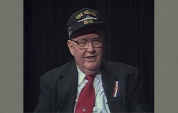
9:28 | Norm Kosarek discusses how he ended up about the USS Wright and his experiences during WWII.
Keywords : USS Wright Pacific Panama Canal
Just before a kamikaze hit the Nevada, the ship's AA guns did enough damage that it broke up and cartwheeled from it's path, which was squarely aimed at Bill Owens. The body of the Japanese pilot was recovered and, later, after the battle and after the dead American sailors were buried at sea, the chaplain insisted that the man get a dignified service. Part 2 of 2.
During the ill-fated Market Garden operation, Hap Chandler's B-24 was not on a bombing mission. His crew was delivering supplies to the 82nd Airborne troops on the ground. He remembers seeing the chaos surrounding the glider operation and, on his way out of there, it occurred to him that he was glad he was up here and not down there.
The officer stumbled upon a group of men hunkered down in a gully during the battle of Aachen. Where's the line? Right here. Where are the Germans? Right over there. Who's in charge here? Silence. Finally, they pointed to Antonio Mendez. He had put the ad hoc group of GIs together and rallied them to fend off the Germans, worthy of a Silver Star. Part 2 of 2.
It was their third mission over Berlin and they were heading home. Four German fighters pounced on the B-24 and it was engulfed in flame and going down. Clyde Burnette fought for consciousness as the other crew in the back of the plane bailed out. He woke in free fall with no idea how he had made it out, and soon he was in German custody. Everyone made it out of the plane except George "Danny" Daneau, the nose turret gunner, who went down with the aircraft.
It was not a pleasant sight. B-24 navigator Hap Chandler could see other planes getting hit, breaking up and the desperation of men in parachutes who did not have good odds on making it safely to the ground. The 8th Air Force had the highest casualty rate in the war, making the air war in the skies of Europe a very deadly business indeed.
After a nerve-wracking mission to bomb Tokyo and a typhoon, B.E. Vaughan and the destroyer O'Brien suffered a second kamikaze attack which killed all three of his hometown pals who served with him on board. Then, began the grim task of collecting the personal belongings of the dead and preparing them for burial at sea.
Michael Mirson was a prisoner of the Germans but that was actually better than being in the Russian Army. He was a trained veterinarian so he was valuable to them as they retreated from the Caucasus. One day, an officer told him that the Americans were fifty kilometers away in that direction and the Russians were close in every other direction. That began a mad dash to the American line.
He didn't even notice that he'd been hit. A piece of shrapnel from a Japanese artillery shell found Harold Barber's leg but he kept right on fighting because of the adrenaline. The Corpsman bandaged him and he was right back in the battle for Peleliu. The Navy was able to stay and take part in the fight unlike when he was on Guadalcanal.
Frank Pomroy prepared his last stand. He had a bayonet wound and three machine gun bullets in his leg but he was still ready to fight. He lined up his hand grenades on the coral ridge in front of him and waited. At daybreak he heard Japanese voices coming. Part 4 of 4. (Second interview)
In the middle of the night, thousands of paratroopers loaded into C-47's for the crossing into Normandy. Carl Beck was just a teenager but he was ready. His plane was hit by flak when it neared the drop zone and the jump was rushed, resulting in scattered men and equipment. Part 1 of 2.
As the fighting raged around Aachen, Antonio Mendez watched men fall all around him. The Germans had a tank with an 88 dug in and it was forcing them to withdraw. Antonio Mendez saw a perfect spot for cover and dove in. He yelled for others to join him and they soon had a good fighting position set up. Before it was over, he had earned a Silver Star. Part 1 of 2.
Two engines were out, a third smoking, and they were were losing airspeed and altitude, but they were flying level and pointed home. Then time ran out for the B-17 and Don Scott had to slip down the hatch into the slipstream. Part 2 of 3.
The first operation for the 4th Division was the landing on Roi-Namur. Lawrence Snowden remembers that, though it was an easy victory, valuable combat experience and important lessons were imparted on the Marines.
For eighteen days the battleship Nevada pummeled the island of Iwo Jima. The problem was that the Japanese had dug in so deep that there was very little effect. The water was deep close to shore so the ship got close enough for Bill Owens to see the hand to hand combat as the Marines ran into a hornets nest.
B-24 navigator Hap Chandler pays tribute to a dear friend from the war, George Brown. Brown led his bomb group to the furious battle in the sky above Schweinfurt where he witnessed some incredible sights. After the war he became a respected professor of mathematics.
Along with thousands of other servicemen, Bill Owens was waiting in the South Pacific, dreading the upcoming invasion of Japan. He knew there would be hordes of kamikazes and the resistance would be desperate and fierce. Then came word of the atomic bomb.
The B-24 crew had trained for their low-level mission at Market Garden by buzzing rural England and making farmers mad. Navigator Hap Chandler remembers the confused and chaotic plight of the men in gliders coming in to that battle. His mission was to drop supplies to the ground troops, flying so low no parachutes were needed.
After the Normandy landings, the battleship Nevada was directed to Cherbourg, where they were directed to knock out big German guns. Bill Owens recalls how a smokescreen was used to hide minesweepers and the big ship as well. The shrapnel from the German artillery was falling like rain on the deck.
It took three navigators. Hap Chandler was the pilotage navigator which meant that he sat in the nose turret with a map and looked for ground markers. Then there was a radar navigator and a dead reckoning navigator who fed instructions to the pilot. In the skies above East Anglia, it was an intricate ballet to get hundreds of planes in formation and carry out the mission.
Bill Owens left the farm in South Carolina and enlisted in the Navy as World War II raged around the world. After an abbreviated basic training he was assigned to the USS Nevada, the only battleship to get underway during the Pearl Harbor attack. His destination, however, was across the Atlantic.
The navigator was the hardest working man on the crew. Hap Chandler filled that role on a B-24 above Northern Europe and was so busy, he didn't have time to be scared. He learned to read the flak explosions to know when it was getting dangerous. If you saw red at the center, it was time to get worried.
As soon as the operation to take Okinawa began, the USS Nevada was hit by a shore battery. For Bill Owens and the rest of the crew, that was just the beginning of the battle. Next came the kamikazes. On the third day a wave of over a hundred of them targeted the fleet. Part 1 of 2.
The training was outmoded and incomplete. B-24 navigator Hap Chandler found out that real combat was totally different. You had to fly really tight formations and so some further training was in order. After a couple of supply missions, he got his first taste of combat over Magdeberg.
Bill Owens had gone to war at seventeen. As a crew member of the USS Nevada, he saw service at Normandy, southern France, Iwo Jima and Okinawa. He had grown up fast and was determined to make a success in life. A friend suggested that he go to school on the GI Bill. The GI Bill? What's that?
The company clerk was Hap Chandler's buddy at the air base in England. He had completed his 35 missions but was due a week off so the clerk sent him to Edinburgh for a little relaxation. It was there that he met the future Mrs. Chandler but he had a little problem back at the base. They were saying he was one mission short.
It was an unbelievable sight over the English Channel. From his 20 mm gun position on the battleship Nevada, Bill Owens could see a vast train of aircraft heading to Normandy and others returning. The sea was full of five thousand ships and it was all targeted on Hitler's war machine.
Just before the firebombing of Dresden, B-24 navigator Hap Chandler flew a mission there but when his flight arrived, the target was obscured by a smoke screen. Fortunately he spotted a railroad yard that made a fine secondary target. It was on that mission that he saw one of the new German rocket planes.
The first step is shore bombardment. The battleship Nevada let loose with it's big guns on the coast of southern France to kick off the operation. Bill Owens remembers how their big boomers were becoming less effective and had diminished range. The guns were simply worn out after the massive effort during the previous campaign at Normandy.
Hap Chandler entered the Army Air Corps in 1943 and raised his hand when they asked who wants to go to navigator school. After that was done, he finished the rest of the training, became part of a crew and set out for Wales in a new B-24. He was nervous about finding Iceland at night but he did and safely landed for the last stop this side of the Atlantic.
What a sight. Bill Owens became emotional when he saw the Statue of Liberty on his way back from the campaigns at Normandy and in the Mediterranean. His ship, the Nevada, was on it's way to dry dock to refit it's worn out guns. But first, a bunch of farm boys were let loose on New York City. Then it was off to the Pacific.